Partager
.svg)
.svg)
Does your eco-anxiety also spike whenever "Artificial Intelligence" is mentioned? And do you also come across comparisons like: "One question to ChatGPT is like turning on an LED bulb for 35 minutes" or "saying hello to your AI consumes the equivalent of a glass of water"? In this article, we'll try not to compare microwaves and AI, but rather to explain the various environmental impacts of AI in a simple way. Our ultimate goal: to give you methods to try and reduce it.
AI accelerates already rampant digital pollution
Every day, you use AI, sometimes without even realizing it. Whether it's by asking a question to Mistral or ChatGPT, letting Netflix suggest a series, or typing a search into Google, artificial intelligence is everywhere. And its impact adds to the already significant impact of the digital world.
- Digital technology, an energy-intensive giant: In 2022, digital technology already accounted for 4.4% of France's CO₂ emissions, a figure that doubled in two years [1].
- AI increases the need for data centers: Data centers have existed for decades to store data, host online services, and "run" the internet. But where AI changes the game is that it demands "hyperscale" data centers, which are much more energy-intensive, and frequent chip replacements. The result? The environmental impact of these infrastructures multiplies. Today, data centers account for 46% of the digital footprint (compared to only 16% in 2020) [2], making them the second largest source of digital pollution in France, after the pollution generated by the manufacturing of devices (computers, phones, networks, etc.).
- Rising emissions among industry giants: The figures from major companies speak for themselves: +23 to 29% in carbon emissions for Microsoft since 2020, +34% for Amazon since 2019. [3] [4]
The good news? We don't have to stand idly by. For example, ADEME offers concrete solutions for more responsible digital practices, starting with raising awareness among those around you: Discover the solutions

Consume or pollute: understanding the two sides of the same impact
When you use AI, you don't see the servers heating up, the vast amounts of water used to cool data centers, or the rare metal mines being depleted. Yet, every single query comes with a very real cost to the planet.
1) On one side, consumption: what we take from the earth, often without knowing it
To function, AI requires:
- Electricity: servers running 24/7, like giant refrigerators always plugged in.
- Water: thousands of liters to prevent data centers from overheating.
- Rare metals: cobalt, lithium, gallium... extracted under often harsh conditions, to manufacture ultra-powerful chips (GPUs).
These resources are extracted, transformed, and transported. These are invisible steps for you, but they also require energy throughout the entire process. This is a resource consumption far removed from the actual usage, making it difficult to account for when measuring AI's impact.
2) On the other side, pollution: what is released into nature when AI is used
The consumption of energy or materials always leads to pollution, whether it is:
- Carbon: the electricity powering your device and running the servers generates a very real carbon footprint, which varies in size depending on whether it's produced with nuclear energy or coal-fired power plants.
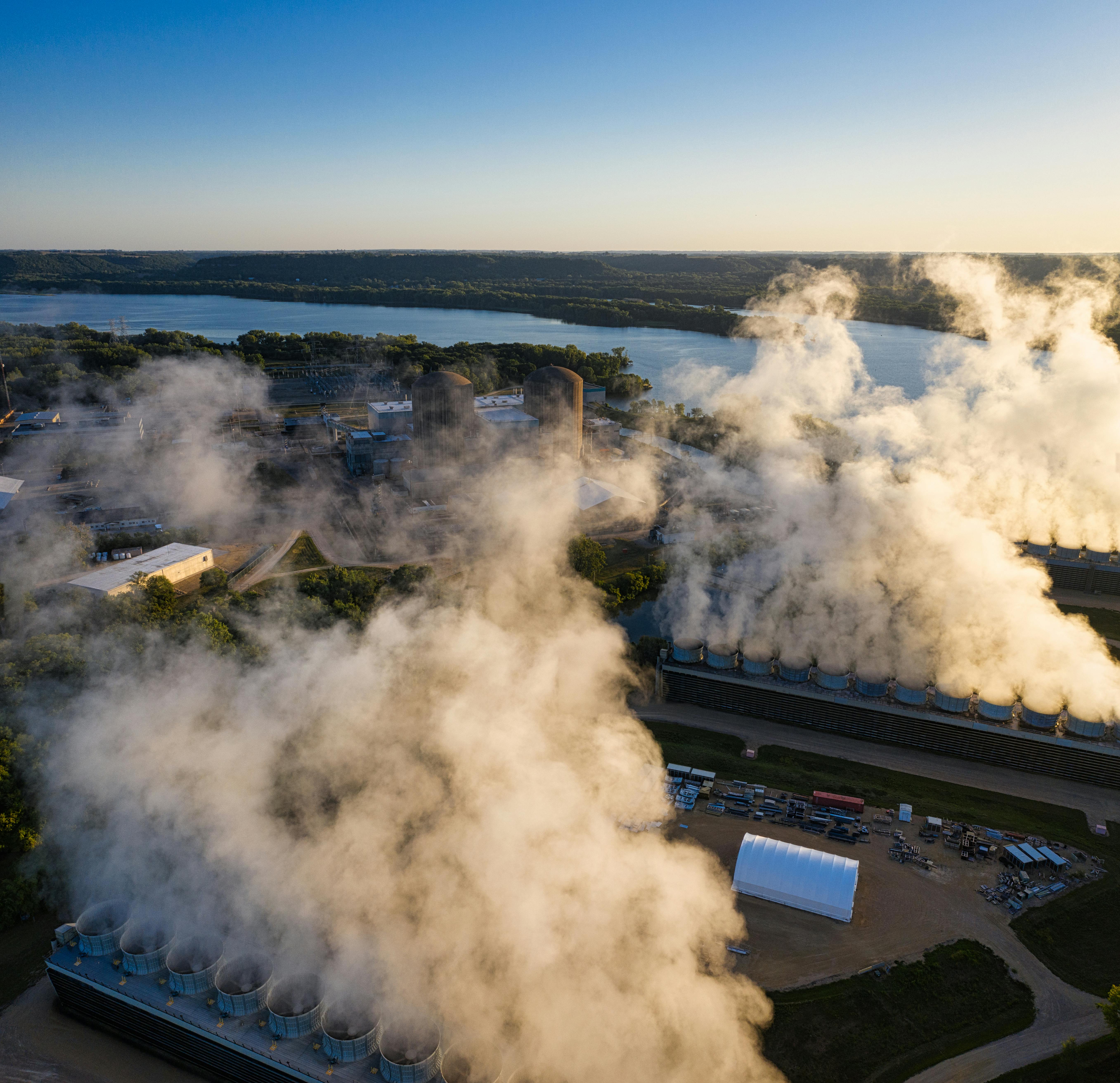
- Thermal: data centers release colossal amounts of thermal energy, often into the environment.
- Physical: the extraction of rare metals (cobalt, lithium, rare earths), necessary for manufacturing equipment, releases chemicals into the soil and waterways.
In summary, it all depends on what you measure. Sometimes, AI's impact is discussed in watt-hours per query (electricity consumed), sometimes in grams of CO2 per query (pollution generated). In reality, to get a complete picture, you need to look at both!
Training vs. Inference: The Great Energy Divide
The environmental impact of AI occurs at two key stages: training and inference.
- Training: the energy marathon
Before answering even a single question, a model must "learn."
This is the training phase, where billions of data points are analyzed to create the model you use today.
This process can last several months, continuously engaging servers: the famous data centers.
The result: a surge in electricity consumption, water for cooling, and indirect CO₂ emissions.
- Inference: the invisible sprint
Once trained, AI "responds." Every time you ask a question, calculations are performed in seconds on remote servers: this phase is called inference. It's fast, but energy-intensive. Processors heat up, consume water, and repeatedly strain already energy-hungry infrastructures. It's a bit like an energy marathon (training) being followed by millions of daily sprints: the queries. It's the sum of all these sprints that ultimately costs the planet the most.
- The rebound effect
The problem with AI is the ease of use and rapid widespread adoption of these tools. Originally, AI promised savings, particularly in terms of saving time, reducing energy expenditure, optimizing human work, and limiting the use of material resources. However, in reality, we observe a greater overall consumption of resources. This phenomenon is called the rebound effect (or Jevons paradox) [7]. It manifests at several levels:
-At the material level: the growing demand for AI services leads to the proliferation of data centers, as well as the accelerated replacement of equipment needed to run increasingly powerful models.
-At the behavioral level: what was originally an occasional use becomes a daily habit [8]
-At the economic level: AI opens the door to new uses and new offerings that didn't exist before: more services, more content, more needs... and therefore more consumption.
Instead of reducing our impact, AI thus tends to shift and amplify energy and material expenditures, so much so that the initial expected gains are often negated by the overall increase in usage.

Why there is no "exact figure"
Want to know the "cost" of a question asked to ChatGPT? Here's why the answer is a puzzle:
Reason #1: There's no standard to uniformly measure data center consumption, unlike sectors such as automotive. While "10L per 100km" allows for comparing the consumption of each car, no common unit of measurement has been formalized for data centers.
Reason #2: No law currently requires data center operators, such as Microsoft or Amazon, to disclose the energy consumption figures of their infrastructures.
And since neither exists, each company is free to provide its own figures, and other organizations perform the calculations. This is why figures can vary considerably - see the example of the figure provided by Meta and challenged by Carbone 4 in this article: Generative AI... and climate change!

How to take action and regain control without guilt
Yes, AI's ecological impact is significant. Yes, answers are still scarce, but no: all is not lost.
Of course, there are individual choices, but above all, strong political decisions need to be made: and they must be championed collectively.
We need to put tech back in its rightful place, move beyond the myth of AI, and stop personifying it.
How? By taking action collectively and individually, without feeling guilty.
Collectively, we can:
- Form or join activist groups (Data for Good, Latitudes, Quadrature du net ...)
- Support digital sobriety and open-source research (e.g., by using Mistral, Hugging Face).
- Encourage public policies in regulation through citizen movements

Individually, you can:
- Educate yourself, read, learn, follow influential people. Fear does not exclude danger, and as often, education is key: you can start with the resources shared throughout this article.
- Question your use of AI: do you really need AI for this task? Is there no other, more responsible way? Digital sobriety also lies in not doing, in reusing existing elements. An AI that doesn't pollute is an AI that isn't used.
- Use the right tools instead of AI: for example, PONS for translation, online checkers, specialized search engines.
- Avoid image generation, and prefer using free image banks like Pexel for example
And if, despite this, AI is essential for the use you want to make of it:
- Prioritize smaller models like https://huggingface.co/chat, https://www.jan.ai/, https://duckduckgo.com/?q=DuckDuckGo+AI+Chat&ia=chat&duckai=1 or use https://openrouter.ai/. The smaller a model is, the less energy it consumes.
- Write short prompts: train yourself in prompting to write shorter, more effective prompts (see tips from France Num). You can also measure the size of your prompts using the tool: https://platform.openai.com/tokenizer
In summary
The impact of AI is very real, but poorly measured. And while we can't (yet) quantify everything, we can already choose to do better.
At Share it, we don't advocate for a return to Minitel, but for reasoned use: using tech when it makes sense, questioning it when it goes astray, and always seeking impact before productivity.
And there are also impact-driven use cases, such as Basic Rules for example.
Since the future will be neither 100% AI nor 0% AI, let's adapt our behaviors to be mindful, smart, and intentional.
It comes from our sources:
[1] Data centers: the not-so-hidden side of the digital world - ADEME Infos. (2025, September 16). ADEME Infos. https://infos.ademe.fr/magazine-janvier-2025/data-centers-la-face-pas-si-cachee-du-numerique/
[2] notre-environnement. (2025, April 10). Digital technology: a rapidly increasing environmental impact. Notre-environnement. https://www.notre-environnement.gouv.fr/actualites/breves/article/numerique-un-impact-sur-l-environnement-en-forte-hausse#:~:text=Les centres de données sont,représente 50 %25 des émissions.
[3] Microsoft – 2025 Environmental Sustainability Report blog, May 29, 2025 blogs.microsoft.com
[4] De Chant, T. (2025, June 2). Breakneck data center growth challenges Microsoft’s sustainability goals.. https://techcrunch.com/2025/06/02/breakneck-data-center-growth-challenges-microsofts-sustainability-goals/
[5] Mace, A. (2025, November 2). Artificial intelligence: the true environmental cost of the AI race. Bon Pote. https://bonpote.com/intelligence-artificielle-le-vrai-cout-environnemental-de-la-course-a-lia/
[6] Bougerol, E.. The environmental cost of AI. Basta! https://basta.media/le-cout-environnemental-de-l-ia
[7] Paper page - From Efficiency Gains to Rebound Effects: The Problem of Jevons’ Paradox in AI’s Polarized Environmental Debate. https://huggingface.co/papers/2501.16548
[8] Ipsos. (2025, August 27). Artificial intelligence: what are the uses of the French? Ipsos. https://www.ipsos.com/fr-fr/intelligence-artificielle-quels-sont-les-usages-des-francais

%20copie%203.png)